
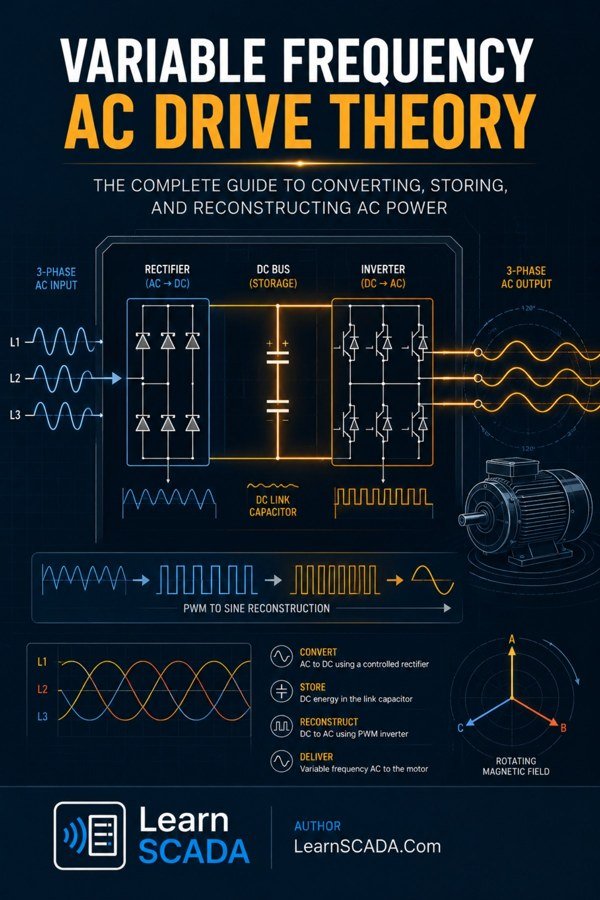
Variable Frequency AC Drive Theory
Coming soon
Open the gray box. A variable frequency drive looks like a sealed box on a wall: power in, a motor cable out, a shaft turning at whatever speed the process needs. What happens in between is the whole subject of this book, and by the last page, the box is transparent.
Built to be seen, this is a visual, ground-up theory of the AC drive. Nearly every idea is paired with a rendered cutaway, an engineering chart, or a clean control diagram, so the physics of rotating fields, pulse-width modulation, and field-oriented control becomes something you can picture, not just parse.
Inside, you follow the drive stage by stage: how three-phase AC builds a rotating field, and why the induction motor must slip behind it to make torque; the power path in full, from rectifier and DC bus to IGBT inverter, and the PWM that paints a sine wave from a switched bus; the control ladder from volts-per-hertz to sensorless and field-oriented vector control and direct torque control; and braking, four-quadrant operation, harmonics and reflected-wave effects, sizing, derating, protection, and the affinity-law energy savings that pay for the drive. No prior drive experience is assumed beyond basic AC theory and Ohm's law. Whether you are a technician, an engineer, or a student, you will finish able to not just trust the drive, but command it.
- Author
- Charles Vance
- Category
- Electronics and Radio